If your work truck needs a USDOT number, the federal marking rule asks for two things on the truck: your legal business name (or the one trade name you registered) and your number with the word "USDOT" in front of it. Both go on both sides of the truck, in letters that contrast sharply with the paint, readable from 50 feet in daylight while the truck is parked. That comes straight from 49 CFR 390.21T, the marking rule as it reads in the eCFR today.
Whether your truck needs a number at all depends on its weight, where it goes and what it hauls. FMCSA's page Do I need a USDOT number? lays out the triggers, and I walk through the ones that matter to Ohio contractors below. Once you know you need it, getting it on the door is the easy part. Truck door lettering and DOT number decals are what I set up for trucks and vans around Columbus, starting at $249 installed for both doors.
One plain note first. This is general information, not legal advice. I letter trucks. I don't decide who needs a number. Confirm your own requirements with FMCSA, or with the Public Utilities Commission of Ohio (PUCO) if your trucks stay in Ohio, before you put anything on the door.
Does your Ohio work truck need a USDOT number?
This is how FMCSA puts it on its USDOT number page. Under the federal rules, you need a number if your vehicle is used in interstate commerce and has a gross vehicle weight rating, gross combination weight rating, gross vehicle weight or gross combination weight of 10,001 pounds or more, whichever is greater. The same page covers vans that carry passengers for pay and trucks that haul hazardous materials in amounts that need a safety permit. Those have their own triggers, so read the page if either one fits you.
Two details are easy to miss:
- Interstate means more than crossing the line. FMCSA counts a trip between two places in Ohio as interstate commerce when it's part of trade that started or ends outside the state. So does a trip from Columbus to a job in Indiana or West Virginia.
- The trailer counts. The test includes the combination rating and combination weight, not only the truck. A pickup that sits under the line by itself can land over it once it's hooked to a loaded trailer. Check the numbers on your door sticker and your trailer before you guess.
Then there's the Ohio piece. FMCSA lists Ohio among the states that require their intrastate commercial vehicle registrants to get a USDOT number. That means a truck that never leaves Ohio can still need one. Which of your trucks that covers, and what Ohio wants on them, is a question for PUCO. I'd call them before I'd guess.
What the DOT lettering has to say
The marking rule in 49 CFR 390.21T is short. Here's what it asks for:
- Your name. Your legal name or a single trade name, the way it's listed on your MCS-150 filing with FMCSA. Not a nickname, not the name on your website if it's different.
- Your number with "USDOT" in front of it. For example, USDOT 123456.
- "Operated by" when it's someone else's truck. If another company's name is on the vehicle, your name and number follow the words "operated by."
You may also have an MC number. FMCSA's operating authority page says companies that haul passengers or federally regulated commodities for pay in interstate commerce need operating authority in addition to a USDOT number. It also says private carriers, the ones hauling their own cargo, aren't required to have it. If you have an MC number, tell me and I'll ask whether you want it on the door too.
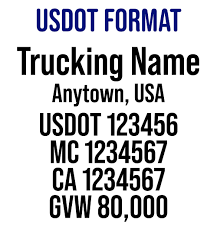
The sample layout at the top of this post shows the usual stack: company name, city, USDOT number, then extra lines like MC and GVW. Only the name and USDOT number come from the marking rule I linked. Anything else is your call, as long as the required lines stay clear and easy to read.
My one firm habit on this: copy your name and number from your registration, letter for letter. Don't type them from memory. A wrong digit on a door is a reprint.
How big, what color and where it goes
The rule I linked doesn't set a letter height. It sets a test: readable from 50 feet, in daylight, with the truck stopped. It also says the letters have to contrast sharply with the background and the marking has to be kept legible. So faded or peeling lettering doesn't pass just because it passed the day it went on.
How I lay it out so it passes that test:
- Doors first. The rule wants both sides, and the doors are the natural spot on most pickups and vans. On box trucks and trailers I'll look at the cab doors and the panels and pick what reads best.
- Strong contrast. White on a dark truck, black on a white one. Skip pale gray on silver or red on maroon.
- Plain, bold letters. Thin script and fancy fonts look good on a logo and fall apart at 50 feet. The DOT line should be boring on purpose.
- Room to breathe. Don't jam the number against a door handle, a body line or the edge of a logo.
After it's installed, do the simple check yourself. Park the truck, walk about 50 feet away and read the number. If you have to squint, it's too small, and I'd rather fix it now than have you find out at a roadside inspection.
Vinyl, magnets or part of a wrap
The marking rule says the lettering can be painted on or be a removable device, as long as the device meets the same rules. That gives you three practical ways to do it:
- Cut vinyl lettering. The usual choice. Single-color letters cut from outdoor vinyl and installed on the doors. It's clean, it lasts, and it's what most people mean by vehicle lettering.
- Magnetic signs. Car magnets work for a truck that does double duty as a personal vehicle. They have to meet the same legibility and contrast test, and they have to be on both sides whenever the truck is working. A magnet in the garage doesn't count.
- Built into a wrap. If you're wrapping the truck or the whole fleet, I design the DOT line into the wrap from the start so it's readable over the graphics. See fleet wraps for how that works.
If you run several trucks, I keep the layout, colors and sizes on file. Truck two matches truck one, and each one gets its own unit number if you want it. That's how I set up fleet and logistics companies in Central Ohio.
How I get it on your door
A DOT lettering job with me goes like this:
- Send me the basics. Your legal or trade name and USDOT number exactly as registered, plus an MC number if you have one. A photo of each door helps. Tell me if the truck is leased.
- Get a quote. I'll send a free quote within 24 hours. Door lettering on both doors with your name and phone starts at $249 installed. I'll price the DOT line and any extra copy right along with it.
- Approve the proof. You see the layout with your real name and number before anything gets cut. Check every digit.
- Install. I work with trusted installers and come to you. No shop to drive to.
First order? Design and setup are free. And if you're not happy with the result, we make it right.
Ready to get your name and number on the truck? Send me your truck photos and registration details and I'll lay it out. And one more time, because it matters: confirm what your trucks need with FMCSA, or with PUCO for Ohio-only questions, before the lettering goes on.
Need this done?
Here's what I make for Columbus and Central Ohio businesses.